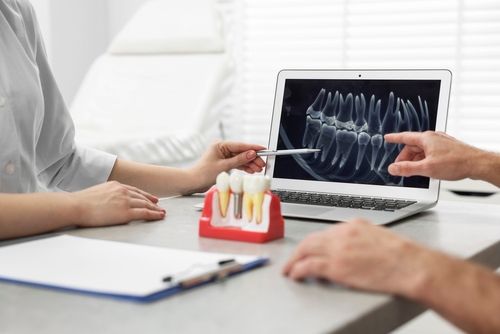
If you were told you have not enough bone for dental implants in Lincolnwood, IL, that news can feel final. Many patients hear that grafting is required, or that implants are simply off the table. In a number of cases, the picture is more hopeful. Smaller-diameter mini implants frequently work in ridges that are too narrow for conventional posts, and that can mean dental implants without bone graft when the site and bite allow it.
Quick answers
Why does the jaw lose bone after tooth loss?Without tooth roots to stimulate the ridge, bone often shrinks in height and width over time.
Can you get implants without a bone graft?Often yes with mini implants, because their smaller diameter usually needs less bone than traditional posts.
Who is a candidate when bone is limited?Many adults with narrow or reduced ridges, if imaging shows enough support for carefully planned mini implants.
What happens at the first visit?A free consult with X-rays, a customized plan, and a full cost outline so you know your options clearly.
Why Bone Loss Happens After Teeth Are Missing
Natural tooth roots do more than hold crowns in place. They transmit chewing forces into the jaw, which helps maintain bone volume. When a tooth is lost and not replaced with a root-like foundation, that stimulation fades. The ridge can thin, flatten, or change shape. Long-term denture wear can add to the change, because a soft-tissue-supported plate sits on the gum rather than loading bone the way a natural root does.
The American Dental Association notes that dental implants are placed in the jawbone to support replacement teeth, which is why bone quality and quantity matter in planning. Mayo Clinic’s overview of dental implant surgery likewise explains that implants need healthy bone, and that grafting is sometimes used when bone is insufficient for a conventional post.
Bone loss is common, and it does not always mean you are out of options. It does mean planning should be careful, with imaging that shows what is available in your ridge today.
Why Traditional Implants Often Lead to Graft Talk
Traditional implants are wider. Placing them typically requires enough bone width and height to house a larger post securely. When the ridge is narrow or has resorbed after years of missing teeth, many treatment plans add grafting first. Grafting can rebuild volume, but it also adds appointments, healing time, cost, and surgical demand before the implant itself is even placed.
That pathway is legitimate for some patients, but it is not the only pathway. When bone is limited, the useful question is often whether a smaller implant can achieve stable function without rebuilding the ridge first.
How Mini Implants Often Avoid Grafting
Mini dental implants are roughly half the diameter of many traditional implants. Because they occupy less space, they can often be placed in ridges that would not comfortably accept a wider post. At Raymond G. Hatland, DDS, placement is usually designed to be gentle: a small pilot pathway, minimal disruption to soft tissue, and in about 99% of suitable cases, direct placement with limited trauma to bone.
Dr. Hatland describes the timeline and technique this way:
“With traditional implants, the process can take four to six months. With mini implants, it’s typically only three to six weeks, depending on the individual case. Mini implants are nonsurgical… In about 99% of cases, the implant is placed directly with minimal trauma, and it begins with roughly 50% integration from the start.”
That early stability matters when bone is sparse. You still need enough quality bone to hold the mini implant securely, but you may not need the extra width that grafting is meant to create for a larger traditional fixture. For many people searching for dental implants without bone graft, that difference is the reason mini implants enter the conversation.
You can also compare broader implant choices on the practice’s dental implants in Lincolnwood page. The goal is matching the post to the anatomy you have, not forcing every case into one surgical template.
Candidacy When Bone Is Limited
Not every limited-bone case is automatic. A thoughtful evaluation looks at:
- Ridge width and height on X-rays
- Gum health and overall healing capacity
- Bite forces and whether you need a single tooth, several teeth, or denture support
- Medical history that may affect bone and recovery
- Whether a removable snap-on, a fixed bridge, or a single crown is the end goal
Patients who were told they have “too little ridge” for a conventional denture or traditional implant are often the ones who benefit most from a second look. Dr. Hatland notes that implant-supported dentures can help when there is too little ridge to hold a traditional denture in place. The same conservative mindset applies to single-tooth and multi-tooth mini implant planning: conserve tissue when possible, and escalate only when needed.
The practice’s dental implant quiz can also help you organize questions before your visit.
What the Process Looks Like
Care begins with a free implant consultation in Lincolnwood. Necessary X-rays are taken. You receive a customized plan and a clear cost outline. In most suitable cases, implants can be placed in a single appointment that typically takes about an hour.
Comfort is a common worry. Dr. Hatland’s view of post-operative sensation is straightforward:
“Because this is a non-surgical placement method, post-operative discomfort is minimal to nearly zero. At most, you might take an aspirin.”
Healing still matters. Final restorations follow once the implants and tissues are ready. Many patients appreciate that the overall mini implant timeline is often measured in weeks rather than the longer traditional sequence. For more detail, see How Long Does the Mini Dental Implant Process Take? and Are Mini Dental Implants Painful?.
A Holistic, Conservative Approach to Limited Bone
Dr. Hatland practices holistic and biological dentistry with decades of implant experience. The aim is not to push every patient into grafting or into the largest possible implant. It is to restore chewing, speech, and facial support with biocompatible materials and the least invasive path that still delivers durable function.
When bone volume is reduced, that philosophy often points toward mini implants: smaller diameter, less surgical trauma in many cases, and a realistic chance to move forward without first rebuilding the ridge. The outcome patients notice first is practical. Eating feels more secure. The smile looks more complete. Daily life stops revolving around what the mouth cannot do.
Soft Next Step: Free Implant Consultation
If you have been told you do not have enough bone for dental implants, a careful second opinion based on current imaging is a calm next step. At your free consult, you will see what your ridge can support today, whether mini implants are appropriate, and what the full cost looks like before any treatment begins.
Call the Lincolnwood office at (773) 338-4440, visit 6453 Lincoln Ave, Lincolnwood, IL 60712, or contact the practice to schedule. Bring prior X-rays if you have them. Many patients discover that “not enough bone” for a traditional implant is not the same as “no implant options at all.”