
Dentures in Lincolnwood, IL
Did you know that losing all of your teeth can change the way your jaw works? Without teeth in place, the jaw joints and muscles have to work much harder to guide movement. There’s no stable bite for the jaw to rely on, so the entire system starts to shift and compensate. Many people who have no natural teeth experience jaw soreness or joint problems because the mouth no longer has the support it was built to use. Dentures help rebuild that support. When you replace the teeth, you give your jaw a clearer path for chewing and speaking. A well-fitting denture helps the joints and muscles work together again, creating a steadier, more comfortable foundation for everyday function.
Fortunately, we can walk you through each option and help you settle on a denture that gives your jaw the support it’s been missing.
Traditional Dentures and Partial Dentures
A traditional denture is a removable appliance that fills the spaces left by missing teeth. It includes a full set of artificial teeth attached to a pink, gum-colored base shaped to match the contours of your mouth. An upper denture covers the palate to create the suction needed for stability, while a lower denture sits along the gum ridge and uses the natural curve of the jaw for support. Some people use denture adhesive for extra steadiness, but the appliance is primarily meant to stay in place through its fit against the gums.
A partial denture is a removable appliance that fills the spaces left by missing teeth while working alongside the natural teeth you still have. It includes artificial teeth attached to a gum-colored base made from acrylic, metal, or a mix of the two. The base is shaped to follow the curves of your gums so it can settle comfortably into the areas where teeth are missing.
To stay steady, the partial denture uses small clasps that gently hook around your natural teeth. These anchors help the appliance stay put as you talk and chew, giving it the support it needs to function throughout the day.
Your Implant Denture Options
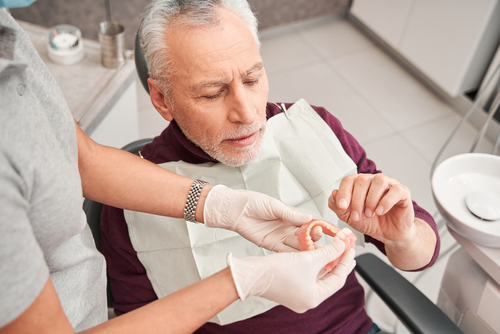
Implant dentures rely on dental implants that serve as firm anchors in the jaw. Dr. Hatland places these small posts into the jawbone, where they begin to integrate with the surrounding bone. As the bone heals, it attaches directly to the titanium in a process known as osseointegration. This fusion locks the implant in place, allowing it to reliably support a denture.
We primarily use mini dental implants, which are narrower than conventional implants and function as a single, solid piece. With the implant and abutment fused together, the ball-shaped top rests just above the gumline as soon as Dr. Hatland places it. That visible portion becomes the connection point for the implant denture, allowing the restoration to attach securely.
Snap-on Dentures
A snap-in denture, often called an overdenture, connects to several mini implants in the jaw. For the lower arch, this usually involves four to six implants, while the upper arch often uses six to eight. Instead of resting loosely on the gums, the denture attaches to the implants through flexible O-rings built into the denture base. These small rubber rings grip the rounded tops of the mini implants when you press the denture into position. The result is a denture that snaps firmly into place and stays stable while you eat and speak.
The O-rings also act as tiny shock absorbers, softening the forces placed on the implants throughout the day and helping the denture feel more comfortable. A snap-in denture looks similar to a traditional denture with its gum-colored base, but the added implant support makes it far more secure. Even though it connects to the implants, you can remove it easily for cleaning or at night. If your current denture fits well and has enough space inside the base, we can often reline it and adapt it to work with mini implants instead of making a brand-new appliance.
Roundhouse Bridge
A roundhouse bridge is a full-arch restoration created as one solid piece. It is milled into a horseshoe shape so it matches the curve of your jaw. The roundhouse bridge replaces all the teeth in an arch with a single, solid unit. The bridge also doesn’t require a plate that sits across the roof of your mouth. This open-palate structure often feels more natural because nothing covers the top of the mouth or interferes with taste. The strong, one-piece structure also gives the bridge the stability needed for everyday chewing while maintaining a lifelike look.
A semi-removable roundhouse bridge connects to six to ten mini implants using a system that locks the bridge into place. You never take it out yourself; you simply clean around it, as you would care for natural teeth. At checkups, Dr. Hatland detaches the bridge for a thorough professional cleaning and then reattaches it.
A non-removable roundhouse bridge attaches to ten to twelve mini implants and stays in place permanently. Once Dr. Hatland secures it, the bridge remains firmly anchored and works much like natural teeth. Because he cements the bridge to the implants, you never have to remove it. You simply brush and care for it the same way you would clean a full set of natural teeth. This option offers the strongest, most stable feel. It gives you more chewing power and a day-to-day function that closely matches what you would expect from natural teeth.
Discover a Denture Solution That Works for You
Every day without stable teeth is a day your jaw works harder than it should. With modern dentures, there’s a better way forward. You deserve a smile that supports your health, your confidence, and your daily routine. If you’re considering your first denture or ready to upgrade to a more secure fit, lasting relief is within reach.
Contact us today to schedule a consultation. Let comfort, function, and peace of mind be part of your everyday life again.
Frequently Asked Questions
There is no exact number of missing teeth required before dentures become an option. What matters most is how well your remaining teeth function and whether they can support a stable bite.
If you still have several healthy teeth, you may benefit from a partial denture. Partials can replace just one tooth or several missing teeth as long as the remaining teeth provide enough support. If most or all of the teeth in a jaw are missing, or the remaining teeth are too damaged to restore, a full denture is usually the most effective choice.
Instead of counting teeth, we look at how your bite works, whether you can chew comfortably, and which teeth are missing. That functional picture helps determine whether a partial or full denture fits your needs.
A sunken appearance often develops because the jawbone naturally shrinks once teeth are gone and no longer stimulate the bone. You can help slow these changes with the right approach.
Implant support offers the strongest long-term protection. Mini dental implants provide the stimulation the bone needs to maintain its shape. This slows bone loss and helps preserve facial structure.
Keeping the fit up to date is important too. As the bone changes over time, dentures can loosen. Regular adjustments and relines help maintain proper support and prevent the sunken look from worsening.
You can sleep with dentures in, but it is not something we recommend doing every night.
Wearing dentures overnight increases the risk of sore spots, irritation, fungal infections, and plaque buildup. Your gums also benefit from time to rest without pressure.
Taking your dentures out before bed allows you to clean and soak them properly. This gives your tissues time to recover and helps keep your mouth healthier and your denture more comfortable.